Wk 13- Complete initial found footage locating and determine where to position the self-generated material. Complete full storyboard and clip-chain structure.
Wk14- Begin editing the footage into the structure of the film, using storyboards to fill the gaps left by footage still to be shot. Shoot initial viewer scenes- 1 actor required, fig rig, tripod, handi and standard cams.
Wk15- Shoot fake Edward Deaux documentary scene- 1 cameraman required. Location to be determined, probably either just outside St Matts or other exterior location.
Wk16- Edit in viewer scenes to complete basic structure, finish scripting the last segments to shoot & organise the Cop Show segment on Frenchay.
Wk 17- Shoot Cop Show segment- 2 actors required, plus flat location on Frenchay Campus. Will require standard camera & tripod.
Wk 18- Edit in Cop Show segment, plan internet reviewer segment, location likely to be on campus in St Matts, with sheet as background and visible screen.
Wk 19- Shoot internet reviewer segment- 1 actor required, tripod, cam & lighting kit, edit in reviewer segment.
Wk 21- Editing. Total structure of film should be in place by this point, no additional material required.
Wk 22- Polish, add credits & final editing
Wk 23- Finish
Wednesday, 14 December 2011

Proposal
My project explores the nature and uses of television, both from a creative and consumer standpoint. The film itself starts with someone viewing television, and then from there we move into the people he's watching also watching TV and so on. Through the course of the film we reach dead ends where there are no screens to use as portals to move onto the next show, returning us to the initial viewer where the process restarts with new shows and material, both found footage and material shot for their piece. As we start to move through more and more screens the pace increases, until eventually we create a complete loop back around to viewing the film of the original viewer displayed on vimeo or youtube.
I want to examine how in spite of our engagement with media that engagement primarily still exists as something used for pleasure. Does it matter if we are passive or active viewers when the primary aim of television is to produce people who watch irrespective of their personal level of engagement?
I'm also aiming to establish an example of how television has become a medium chiefly used to examine and reference itself, providing entertainment to its viewers but building almost entirely on it's own ideas and forms creating what Baudrillard refers to as Hyperreality. By layering shows and films together and joining them through the act of watching we establish a tree of influences and screen media as a self-consuming industry, propagating the act of watching as a cultural norm and enforcing ways and methods of constructing reality both on and off the screen.
Blog 7
Just completed my final edit of my film, clocking in at around 3 minutes and 30 seconds including credits. I know it's only a pilot but I figure the suggestions from first year still apply regarding acknowledging the university on web-available material, since we used UWE equipment. Plus I wanted to provide a complete list of clips and additions.
In a shift from my original idea I ditched the voiceover last night both because it felt lazy and pretentious. The original text was some variation of the following-
"Watching for something. For an escape. For Ideas. Am I passive or active? Do I engage or am I absorbed? Am I copying others or building something of my own? Am I looking for inspiration or oblivion?"
When creating these sorts of projects I always think about how the concept will play at the end of year show and frankly, even though the exploration of ideas with traditionally low-cultural value material is my aim, the distance for the audience between high-minded preaching and the down and dirty of the concept was too much. I'm also mindful of the 'show don't tell' principle, and with a VO I'm just explaining the idea instead of letting people explore it. Instead I assembled a series of audio clips from various shows to establish the theme of blankly watching without seeming to react. I took shows that represent a variety of material and edited it in as though channel-surfing, and in that way Hot Fuzz is just another thing stage in the theme. One important aspect in choosing the extra shows was how they reference other TV. The SNL segment is a fake live news report, Larry Sanders is a show about a TV chat show etc. There's other aspects mixed in for flavour, like Japanese anime (that culture is an aspect we'll revisit in B&BH) and Homeland, a show that uses a mix of real and produced audio and footage in it's opening titles. Black Mirror is a sci-fi drama about a talent show, so I took a segment of the performance from that to both represent and have an implied critique of the talent genre for those that spot the reference. UFC added a live sports production and How I Met Your Mother traditional sitcom, just to try and generate an even sample and realistic variation of material (any montage of modern television would represent those genres somewhere).
In the end I feel my pilot represents a great deal of thought and ideas but perhaps has an issue emphasizing it's point with it's short running time and perhaps choices I made in the media. The recognition of the characters used tends to override any point I'm trying to make so far, it may be beneficial to use a wider range of less iconic characters in the final result, perhaps finding clips to do the exposition for me indirectly.
In a shift from my original idea I ditched the voiceover last night both because it felt lazy and pretentious. The original text was some variation of the following-
"Watching for something. For an escape. For Ideas. Am I passive or active? Do I engage or am I absorbed? Am I copying others or building something of my own? Am I looking for inspiration or oblivion?"
When creating these sorts of projects I always think about how the concept will play at the end of year show and frankly, even though the exploration of ideas with traditionally low-cultural value material is my aim, the distance for the audience between high-minded preaching and the down and dirty of the concept was too much. I'm also mindful of the 'show don't tell' principle, and with a VO I'm just explaining the idea instead of letting people explore it. Instead I assembled a series of audio clips from various shows to establish the theme of blankly watching without seeming to react. I took shows that represent a variety of material and edited it in as though channel-surfing, and in that way Hot Fuzz is just another thing stage in the theme. One important aspect in choosing the extra shows was how they reference other TV. The SNL segment is a fake live news report, Larry Sanders is a show about a TV chat show etc. There's other aspects mixed in for flavour, like Japanese anime (that culture is an aspect we'll revisit in B&BH) and Homeland, a show that uses a mix of real and produced audio and footage in it's opening titles. Black Mirror is a sci-fi drama about a talent show, so I took a segment of the performance from that to both represent and have an implied critique of the talent genre for those that spot the reference. UFC added a live sports production and How I Met Your Mother traditional sitcom, just to try and generate an even sample and realistic variation of material (any montage of modern television would represent those genres somewhere).
In the end I feel my pilot represents a great deal of thought and ideas but perhaps has an issue emphasizing it's point with it's short running time and perhaps choices I made in the media. The recognition of the characters used tends to override any point I'm trying to make so far, it may be beneficial to use a wider range of less iconic characters in the final result, perhaps finding clips to do the exposition for me indirectly.
Sunday, 11 December 2011
Blog 6
Finished my editing process bar adding a shot voiceover monologue over the opening footage. I've gone back and forth over whether it's something that needs doing but incorporating the 50 second still shot of me lit only by static is something I really want to do. However whilst the flickering light and the attempts by the camera to compensate make the image interesting it does need a little exposition just to explain what it is I'm trying to do. I've written and recorded the voiceover and plan to add it on monday.
In sifting through my own footage I decided to use the advice of my tutors and ditch the drug and scientific experiment motif. The theme and editing should be strong enough for this project to stand on. I initially chose the drug as a plot device, similar to the drugs and machines in Inception, a requirement but not to be focussed upon. However now I feel that incorporating that element into such a motionless opening would only complicate the ideas I'm trying to convey with a clumsy metaphor of TV as drugs.

Expanding on my last blog- In the end after toying with editing footage of three films in I settled on two, Hot Fuzz and Beavis and Butthead. The third film, True Romance, has a great deal of potential and will be a part of my final project but including a third film might have overcomplicated the idea for the pilot. An initial edited version with it included still exists and I plan to use this as a starting point for my actual film.

I've also completed rough drafts of the 6 parts of my research report. There's some extraneous or duplicated material I might excise before submission but I think it works as a mission statement for my work so far. Only my Proposal and Production Schedule remain. The majority of my early schedule over Christmas will consist of organising a timeline and storyboard for my scenes and doing initial editing on those sections. Once those are prepared I'll shoot my own short 30 second contributions of connecting material. The production requirements for my own shooting are relatively low, perhaps a couple of hours a day for two or three days at most so I've no issue delaying those until I feel my films' overall structure starting to take shape.
In sifting through my own footage I decided to use the advice of my tutors and ditch the drug and scientific experiment motif. The theme and editing should be strong enough for this project to stand on. I initially chose the drug as a plot device, similar to the drugs and machines in Inception, a requirement but not to be focussed upon. However now I feel that incorporating that element into such a motionless opening would only complicate the ideas I'm trying to convey with a clumsy metaphor of TV as drugs.
Inception Dream Machine
Expanding on my last blog- In the end after toying with editing footage of three films in I settled on two, Hot Fuzz and Beavis and Butthead. The third film, True Romance, has a great deal of potential and will be a part of my final project but including a third film might have overcomplicated the idea for the pilot. An initial edited version with it included still exists and I plan to use this as a starting point for my actual film.

True Romance's lead characters meet in the cinema
I've also completed rough drafts of the 6 parts of my research report. There's some extraneous or duplicated material I might excise before submission but I think it works as a mission statement for my work so far. Only my Proposal and Production Schedule remain. The majority of my early schedule over Christmas will consist of organising a timeline and storyboard for my scenes and doing initial editing on those sections. Once those are prepared I'll shoot my own short 30 second contributions of connecting material. The production requirements for my own shooting are relatively low, perhaps a couple of hours a day for two or three days at most so I've no issue delaying those until I feel my films' overall structure starting to take shape.
Research Report- 6. Bibliography & Mediography
Bibliography
Brunsdon, Charlotte (Spring 2008) Is Television Studies History?, Cinema Journal 47 No 3, pp 127-137 available through: Project Muse (accessed 01/12/11)
Dawson, Mike (2008) The First Ten Minutes of Serenity, available at http://www.leftfieldcinema.com/analysis-the-first-ten-minutes-of-serenity (accessed 01/12/11)
Denzin, Norman K (1995) The Cinematic Society: The Voyeurs Gaze, London, Sage
Manlove, Clifford T (Spring 2007) Visual Drive & Cinematic narrative in Lacan, Hitchcock & Mulvey, Cinema Journal 46, no 3 available through: Project Muse (accessed 14/11/11)
Mulvey, Laura (Spring & Fall 2009) Some Reflections on the Cinephilia Question, Framework: The Journal of Cinema & Media, Vol 5 No's 1 & 2
Mulvey, Laura (2009) Visual and Other Pleasures (2nd edition), Hampshire, Palgrave Macmillan
Mediography
Beavis & Butthead Do America (1996) DVD, Directed by Mike Judge, US, Paramount Pictures
Black Mirror (2011) TV, Created by Charlie Brooker, UK, Endemol
Bleach (2004- present) TV, Directed by Noriyuki Abe, Japan, Studio Perriot
Community (2009- present) TV, Created by Dan Harmon, US, Sony Pictures Television
Gazorra (2009) TNG Episode 16 - Picart, (Video Online) available online at
http://www.youtube.com/watch?v=p7jbP1_H9sA&feature=channel_video_title (accessed 15/11/11)
Homeland (2011) TV, Developed by Howard Gordon & Alex Ransa, US, Showtime Original Productions
Hot Fuzz (2007) DVD, Directed by Edgar Wright, UK, Universal Pictures
How I Met Your Mother (2005- present) TV, created by Carter Bays & Craig Thomas, US, 20th Century Fox Television
The Larry Sanders show (1992-1998) TV, Created by Garry Shandling, US, Sony Pictures Television
Pbonanno (2011) George C Scott watches the Jack & Jill trailer, (Video Online) available at-
http://www.youtube.com/watch?v=qKSAvNOIaNo (accessed 15/11/11)
Saturday Night Live (1975- present) TV, Created by Lorne Michaels, US, NBC & SNL Studios
UFC 140 (2011) PPV TV, Produced by Dana White & Lorenzo Fertitta, US, Zuffa Inc
Brunsdon, Charlotte (Spring 2008) Is Television Studies History?, Cinema Journal 47 No 3, pp 127-137 available through: Project Muse (accessed 01/12/11)
Dawson, Mike (2008) The First Ten Minutes of Serenity, available at http://www.leftfieldcinema.com/analysis-the-first-ten-minutes-of-serenity (accessed 01/12/11)
Denzin, Norman K (1995) The Cinematic Society: The Voyeurs Gaze, London, Sage
Manlove, Clifford T (Spring 2007) Visual Drive & Cinematic narrative in Lacan, Hitchcock & Mulvey, Cinema Journal 46, no 3 available through: Project Muse (accessed 14/11/11)
Mulvey, Laura (Spring & Fall 2009) Some Reflections on the Cinephilia Question, Framework: The Journal of Cinema & Media, Vol 5 No's 1 & 2
Mulvey, Laura (2009) Visual and Other Pleasures (2nd edition), Hampshire, Palgrave Macmillan
Mediography
Beavis & Butthead Do America (1996) DVD, Directed by Mike Judge, US, Paramount Pictures
Black Mirror (2011) TV, Created by Charlie Brooker, UK, Endemol
Bleach (2004- present) TV, Directed by Noriyuki Abe, Japan, Studio Perriot
Community (2009- present) TV, Created by Dan Harmon, US, Sony Pictures Television
Gazorra (2009) TNG Episode 16 - Picart, (Video Online) available online at
http://www.youtube.com/watch?v=p7jbP1_H9sA&feature=channel_video_title (accessed 15/11/11)
Homeland (2011) TV, Developed by Howard Gordon & Alex Ransa, US, Showtime Original Productions
Hot Fuzz (2007) DVD, Directed by Edgar Wright, UK, Universal Pictures
How I Met Your Mother (2005- present) TV, created by Carter Bays & Craig Thomas, US, 20th Century Fox Television
The Larry Sanders show (1992-1998) TV, Created by Garry Shandling, US, Sony Pictures Television
Pbonanno (2011) George C Scott watches the Jack & Jill trailer, (Video Online) available at-
http://www.youtube.com/watch?v=qKSAvNOIaNo (accessed 15/11/11)
Saturday Night Live (1975- present) TV, Created by Lorne Michaels, US, NBC & SNL Studios
UFC 140 (2011) PPV TV, Produced by Dana White & Lorenzo Fertitta, US, Zuffa Inc
Research Report- 5. Production Planning
Required materials- Fig Rig, Tripod, Camera & handicam. Apple laptop, University Apple, home PC & 2 storage drives both 500gb.
Software- Goldwave audio editing software (I own a copy), WinX DVD ripper Platinum (trial version sufficient) & Final Cut (university).
Cast- at least 5, culled from classmates and willing volunteers. I want to recast the viewer since I'm looking to incorporate the Edward Deaux character I used in my film last year as part of my chain (as a heavily media-influenced character he fits the theme) and since that's me I wish to avoid confusion. At the moment I'm looking at creating a 3 person rudimentary cop show (two cops, one perpetrator) and an internet-style movie review show in addition to a fake documentary segment with Edward.
Locations-
Cop Show- Frenchay Campus halls. (Cast Toby & other campus residents)
Viewer location- My flat
Review show- Converted st matts classroom with drapes background, chair & desk.
Fake Documentary- Street location with Edward working on his film on a mac in his car, most likely directly outside of St Matts.
Additional footage- So far I've assembled clips from the following films and shows- Community, Friends, Black Books, Scream, 500 Days of Summer, True Romance, Star Trek TNG, The West Wing, The Wire, Beavis & Butthead Do America, Hot Fuzz, Buffy the Vampire Slayer and The Simpsons. Additional footage may be required but these are the raw materials with which I plan to work.
Software- Goldwave audio editing software (I own a copy), WinX DVD ripper Platinum (trial version sufficient) & Final Cut (university).
Cast- at least 5, culled from classmates and willing volunteers. I want to recast the viewer since I'm looking to incorporate the Edward Deaux character I used in my film last year as part of my chain (as a heavily media-influenced character he fits the theme) and since that's me I wish to avoid confusion. At the moment I'm looking at creating a 3 person rudimentary cop show (two cops, one perpetrator) and an internet-style movie review show in addition to a fake documentary segment with Edward.
Locations-
Cop Show- Frenchay Campus halls. (Cast Toby & other campus residents)
Viewer location- My flat
Review show- Converted st matts classroom with drapes background, chair & desk.
Fake Documentary- Street location with Edward working on his film on a mac in his car, most likely directly outside of St Matts.
Additional footage- So far I've assembled clips from the following films and shows- Community, Friends, Black Books, Scream, 500 Days of Summer, True Romance, Star Trek TNG, The West Wing, The Wire, Beavis & Butthead Do America, Hot Fuzz, Buffy the Vampire Slayer and The Simpsons. Additional footage may be required but these are the raw materials with which I plan to work.
Research Report- 4. Pilot
My pilot aims to explore the self-referential nature and addictive voyeurism of television and other screen media. In the beginning we see for the first and only time the perspective of the television watching the viewer, the gaze that is impossible to actually return. By adding the convention of static to the image I reduced the viewer to just another aspect of the medium, immediately it is implied that there may be no clear level of reality we are supposed to identify with. As we move between the films we see one influencing the other but doing so in ways that heavily reference other material. At the end we see there is no further screen to move through, disrupting the center of those characters lives. The act of watching has become habitual, even addictive.
For the full production I need to perhaps establish both more elaborate ways of moving through the levels. By the end I want to be moving so fast that we shoot through maybe ten clips in a minute. I'll need to elaborate on the effects and editing I've already managed in order to make the final product work as a finished piece. I also need to establish and place my own segments within the sequence, once I've picked out which films and shows best fit my theme and can be placed within it I can create segments that bind together those segments, designing them around the existing text and making the transitions more cohesive.
For the full production I need to perhaps establish both more elaborate ways of moving through the levels. By the end I want to be moving so fast that we shoot through maybe ten clips in a minute. I'll need to elaborate on the effects and editing I've already managed in order to make the final product work as a finished piece. I also need to establish and place my own segments within the sequence, once I've picked out which films and shows best fit my theme and can be placed within it I can create segments that bind together those segments, designing them around the existing text and making the transitions more cohesive.
Thursday, 8 December 2011
Research Report- 3. Research
My research for this project began with an analysis of my own practices and uses of television, tying in with observations about the self-referential nature of screen culture. In order to further explore this I watched and made notes on other explicitly pop-culture influenced works, such as the work of director Edgar Wright or Mike Judge, as well as TV shows like Community which commentate on the influences and production methods of modern creators.
I also looked to explore a potential addictive element to viewing as a pleasurable exercise. Laury Mulvey expands on Freud to explore both the libido-driven Scopophilic and ego orientated identification with characters and narrative. Both aspects are a crucial part of the way she believes we derive pleasure from looking, particularly in cinema. Norman K Denzin offers a far more diverse picture of the voyeuristic nature of film. In addition like Denzin my hypothesis is that screen media, contrary to offering a scientific eye through which reality may be clearly captured and examined instead is only understandable through textual constructions, by reducing the images to familiar forms and ways of looking. By using this constructed way of looking we derive pleasure which is why we return again and again spending hours each day watching similar material. There is no fundamental difference between what we absorb and what the creators do and as a result what we are fed has no better connection with reality, instead the result is what Baudrillard referred to as Hyperreality. I plan to further explore this idea as well as the implications of voyeurism to improve my project.
I also looked to explore a potential addictive element to viewing as a pleasurable exercise. Laury Mulvey expands on Freud to explore both the libido-driven Scopophilic and ego orientated identification with characters and narrative. Both aspects are a crucial part of the way she believes we derive pleasure from looking, particularly in cinema. Norman K Denzin offers a far more diverse picture of the voyeuristic nature of film. In addition like Denzin my hypothesis is that screen media, contrary to offering a scientific eye through which reality may be clearly captured and examined instead is only understandable through textual constructions, by reducing the images to familiar forms and ways of looking. By using this constructed way of looking we derive pleasure which is why we return again and again spending hours each day watching similar material. There is no fundamental difference between what we absorb and what the creators do and as a result what we are fed has no better connection with reality, instead the result is what Baudrillard referred to as Hyperreality. I plan to further explore this idea as well as the implications of voyeurism to improve my project.
Wednesday, 7 December 2011
Research Report- 2. Similar Work
I'm deliberately looking at almost any film or TV show that explicitly endorses or promotes the act of watching a screen. Is it that screens are so ubiquitous that films are bound to reflect that or is it that the sort of people who are likely to make films are more likely to prioritise films and TV shows as a significant cultural influence? At first my initial influences on the practical side were youtube videos, taking footage from films and TV and recontextualising it. The practice is so widespread that I started thinking about creative works that directly use or are explicitly influenced by other films or TV. I’m also looking at works that explore narrative loops, most particularly the work of Charlie Kaufman in Adaptation and Synecdoche, New York.
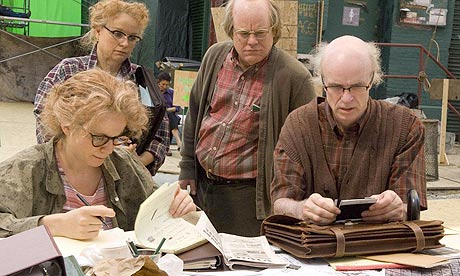
Synecdoche in particular creates a loop where the real lead is recreating his own life using actor in performance art and thus because his entire life is creating this work that’s what it becomes, a repetitive loop. However the difference is that whilst in the film the mimics find ways to be different the shows I'm looking at will try to be different but still be limited by the habits of the medium. Structurally it mimics something like Inception with TV shows replacing dreams. I’m in effect trying to create a theoretical tree of influence, altering footage to make it visually practical and explicit. If in Hot Fuzz Simon Pegg and Nick Frost were originally watching Point Break it’s hard to illustrate through that film what the influences of Point Break were. If I switch it to Beavis and Butthead I can demonstrate the idea of the chain of media influences more clearly. It’s like being able to show consumption as an essential influence in creation, but also a restrictive one since replication of ideas is less creative that something that is original in and of itself.
Synecdoche's Caden oversees the actor playing himself
Synecdoche in particular creates a loop where the real lead is recreating his own life using actor in performance art and thus because his entire life is creating this work that’s what it becomes, a repetitive loop. However the difference is that whilst in the film the mimics find ways to be different the shows I'm looking at will try to be different but still be limited by the habits of the medium. Structurally it mimics something like Inception with TV shows replacing dreams. I’m in effect trying to create a theoretical tree of influence, altering footage to make it visually practical and explicit. If in Hot Fuzz Simon Pegg and Nick Frost were originally watching Point Break it’s hard to illustrate through that film what the influences of Point Break were. If I switch it to Beavis and Butthead I can demonstrate the idea of the chain of media influences more clearly. It’s like being able to show consumption as an essential influence in creation, but also a restrictive one since replication of ideas is less creative that something that is original in and of itself.
Research Report- 1. Theoretical context
With my project I'm examining the ways people use television and other potentially passive screen media. I don't mean to make cinema wholly distinct but for the purposes of my project any screen media in mass home and personal consumption I'm basically classifying under television. Cinema is defined not just by what you watch but how and where you see it, it's an active process to go out and see it. This idea doesn't extend to interactive media such as use of the internet and games either, purely for media where there's an already existing line of thought surrounding our passive or engaged status as an audiance. There is of course a existing perspective of what screen media can do, Alfred Hitchcock said "Watching a well-made film we don't sit by as spectators, we participate".
To explore this I turned to the use of the gaze and Laura Mulvey's exploration of Freud's ideas around Scopophilia. Mulvey's focus is on both the temporary loss of ego as watching the screen causes the viewer to forget themselves, as well as the pleasure derived from watching others. I'm looking to examine how on screen viewers also lose themselves in the act of watching and gain pleasure from it. The act of losing yourself both embeds you as active in relation to the narratives presented and also potentially removes you from active critical judgment, it removes your distance from what you are watching by substituting pleasure. Is the active/passive debate as simple as we think?
As time has passed we've seen the benefits of this participation, as films and television play an important part in inspiring their own evolution, but in doing so build on each other instead of reality. References to classic cinema aren't just small in-jokes like a Charleton Heston movie playing in the background of 2011's Planet of the Apes, they're inherent to the way modern film and television occur. Even cutting edge television like Community or Black Mirror makes use of references both explicitly in the script and through aspects such as casting choices or style. Modern screen culture is essentially almost entirely self-referential, and the result is what Baudrillard referred to as hyperreality.
To explore this I turned to the use of the gaze and Laura Mulvey's exploration of Freud's ideas around Scopophilia. Mulvey's focus is on both the temporary loss of ego as watching the screen causes the viewer to forget themselves, as well as the pleasure derived from watching others. I'm looking to examine how on screen viewers also lose themselves in the act of watching and gain pleasure from it. The act of losing yourself both embeds you as active in relation to the narratives presented and also potentially removes you from active critical judgment, it removes your distance from what you are watching by substituting pleasure. Is the active/passive debate as simple as we think?
As time has passed we've seen the benefits of this participation, as films and television play an important part in inspiring their own evolution, but in doing so build on each other instead of reality. References to classic cinema aren't just small in-jokes like a Charleton Heston movie playing in the background of 2011's Planet of the Apes, they're inherent to the way modern film and television occur. Even cutting edge television like Community or Black Mirror makes use of references both explicitly in the script and through aspects such as casting choices or style. Modern screen culture is essentially almost entirely self-referential, and the result is what Baudrillard referred to as hyperreality.
Blog 5
The experimental shooting yielded some interesting results, the camera doesn't work so well reflecting widespread light from the static screen in the room but in close-ups I was able to get some interesting illumination. In addition the shots of the static itself can be used to frame the idea as a product of the screen itself.
At the moment my editing on the pilot is progressing nicely, I've decided to restrict the idea to the initial shots off myself in the room and two films. This is due to the extended length and continuity issues that including three films would result in, this would be fine for the complete film but for a short illustrative pilot it's not required. The themes and ideas I need to demonstrate are evident just from the two. For this pilot I've picked out two prime examples of how modern screen culture is self-consuming, Hot Fuzz and Beavis & Butthead.

Hot Fuzz of course makes regular and explicit use of film references, the act of watching Point Break and Bad Boys 2 influences the entire second half of the film.

Beavis and Butthead's entire lives revolve around watching, commentating on and imitating television. With the chain idea of me watching Hot Fuzz and them watching Beavis and Butthead and Beavis and Butthead looking to TV for direction we get an explicit theme of watching not just casually but as a way of thinking.
At the moment my editing on the pilot is progressing nicely, I've decided to restrict the idea to the initial shots off myself in the room and two films. This is due to the extended length and continuity issues that including three films would result in, this would be fine for the complete film but for a short illustrative pilot it's not required. The themes and ideas I need to demonstrate are evident just from the two. For this pilot I've picked out two prime examples of how modern screen culture is self-consuming, Hot Fuzz and Beavis & Butthead.
Hot Fuzz of course makes regular and explicit use of film references, the act of watching Point Break and Bad Boys 2 influences the entire second half of the film.
Beavis and Butthead's entire lives revolve around watching, commentating on and imitating television. With the chain idea of me watching Hot Fuzz and them watching Beavis and Butthead and Beavis and Butthead looking to TV for direction we get an explicit theme of watching not just casually but as a way of thinking.
Subscribe to:
Comments (Atom)