Wednesday, 7 December 2011

Research Report- 2. Similar Work


I'm deliberately looking at almost any film or TV show that explicitly endorses or promotes the act of watching a screen. Is it that screens are so ubiquitous that films are bound to reflect that or is it that the sort of people who are likely to make films are more likely to prioritise films and TV shows as a significant cultural influence? At first my initial influences on the practical side were youtube videos, taking footage from films and TV and recontextualising it. The practice is so widespread that I started thinking about creative works that directly use or are explicitly influenced by other films or TV. I’m also looking at works that explore narrative loops, most particularly the work of Charlie Kaufman in Adaptation and Synecdoche, New York. 
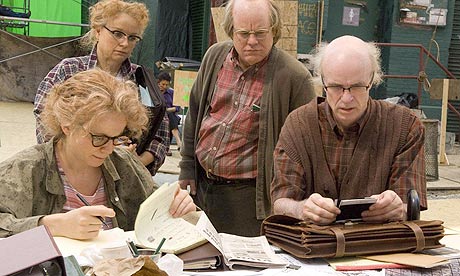
 Synecdoche's Caden oversees the actor playing himself

Synecdoche in particular creates a loop where the real lead is recreating his own life using actor in performance art and thus because his entire life is creating this work that’s what it becomes, a repetitive loop. However the difference is that whilst in the film the mimics find ways to be different the shows I'm looking at will try to be different but still be limited by the habits of the medium. Structurally it mimics something like Inception with TV shows replacing dreams. I’m in effect trying to create a theoretical tree of influence, altering footage to make it visually practical and explicit. If in Hot Fuzz Simon Pegg and Nick Frost were originally watching Point Break it’s hard to illustrate through that film what the influences of Point Break were. If I switch it to Beavis and Butthead I can demonstrate the idea of the chain of media influences more clearly.  It’s like being able to show consumption as an essential influence in creation, but also a restrictive one since replication of ideas is less creative that something that is original in and of itself.

Research Report- 1. Theoretical context

With my project I'm examining the ways people use television and other potentially passive screen media. I don't mean to make cinema wholly distinct but for the purposes of my project any screen media in mass home and personal consumption I'm basically classifying under television. Cinema is defined not just by what you watch but how and where you see it, it's an active process to go out and see it. This idea doesn't extend to interactive media such as use of the internet and games either, purely for media where there's an already existing line of thought surrounding our passive or engaged status as an audiance. There is of course a existing perspective of what screen media can do, Alfred Hitchcock said "Watching a well-made film we don't sit by as spectators, we participate".

To explore this I turned to the use of the gaze and Laura Mulvey's exploration of Freud's ideas around Scopophilia. Mulvey's focus is on both the temporary loss of ego as watching the screen causes the viewer to forget themselves, as well as the pleasure derived from watching others. I'm looking to examine how on screen viewers also lose themselves in the act of watching and gain pleasure from it.  The act of losing yourself both embeds you as active in relation to the narratives presented and also potentially removes you from active critical judgment, it removes your distance from what you are watching by substituting pleasure. Is the active/passive debate as simple as we think?

As time has passed we've seen the benefits of this participation, as films and television play an important part in inspiring their own evolution, but in doing so build on each other instead of reality. References to classic cinema aren't just small in-jokes like a Charleton Heston movie playing in the background of 2011's Planet of the Apes, they're inherent to the way modern film and television occur. Even cutting edge television like Community or Black Mirror makes use of references both explicitly in the script and through aspects such as casting choices or style. Modern screen culture is essentially almost entirely self-referential, and the result is what Baudrillard referred to as hyperreality.

Blog 5

The experimental shooting yielded some interesting results, the camera doesn't work so well reflecting widespread light from the static screen in the room but in close-ups I was able to get some interesting illumination. In addition the shots of the static itself can be used to frame the idea as a product of the screen itself.

At the moment my editing on the pilot is progressing nicely, I've decided to restrict the idea to the initial shots off myself in the room and two films. This is due to the extended length and continuity issues that including three films would result in, this would be fine for the complete film but for a short illustrative pilot it's not required. The themes and ideas I need to demonstrate are evident just from the two. For this pilot I've picked out two prime examples of how modern screen culture is self-consuming, Hot Fuzz and Beavis & Butthead.


Hot Fuzz of course makes regular and explicit use of film references, the act of watching Point Break and Bad Boys 2 influences the entire second half of the film.


Beavis and Butthead's entire lives revolve around watching, commentating on and imitating television. With the chain idea of me watching Hot Fuzz and them watching Beavis and Butthead and Beavis and Butthead looking to TV for direction we get an explicit theme of watching not just casually but as a way of thinking.

Wednesday, 23 November 2011

Blog 4

Starting my own principle photography/experimental shooting this weekend. The main objective of this is to produce footage for editing to discover what is feasible and what isn't, but also to create material for my pilot/trailer. Initial equipment includes the Panasonic HMD HC and S10 HD video cameras, a tripod and a figrig. The main objectives are to experiment with how a TV lights a room as the sole source of illumination. I also aim to explore how the figrig allows me to use the space, possibly experimenting with zooming into the screen itself. These questions of feasibility are key, since they determine whether my  project is viable in it's current form, both from a plot and practical standpoint.

In examining TV for self-referential-ism I found plenty of examples to use. For instance the show Community interested me, it's built around a TV-friendly mix of characters from diverse ethnic and social backgrounds. One of the characters, Abed, is an active filmmaker with an undiagnosed form of Asbergers. He consumes vast amounts of TV and reproduces it both in his own works and in day to day life, understanding everyday life through the framework of television, to the point where he often considers himself a viewer instead of a participant, a substitute for the audience. This perspective on the creator/consumer character as a mimic to an absurd degree for comedic effect is an interesting commentary both on the creators both of this show and indeed of television at large.

Tuesday, 15 November 2011

Blog 3.5- Ideas and examples

With recontextualisation of footage potentially being key to my project I thought I'd include some examples of materials where this is done well. They're mostly short internet videos and comedy-orientated but still relevant I think-


I've made progress in ripping DVD's in a high def format, which can now be used for more conceptual editing attempts.. I've also reduced the audio tracks from 4-6 to just normal stereo.

I also took ideas from Mike Dawson's analysis of the first 10 minutes of the 2005 film Serenity, in which an expositionary video is revealed as a classroom which is in turn a dream, which is a security recording. It sounds convoluted but until you actually think about the structure it seems natural and reveals a great deal of the overall backstory for the film in a short period. Whilst I'm probably not using it as an overall plot there is thematic significance that I can reveal by my choices at each stage.

http://www.leftfieldcinema.com/analysis-the-first-ten-minutes-of-serenity

Wednesday, 9 November 2011

Blog 3

I've started using DivX DVD ripper Platinum trial version to start compiling my found footage directly into MOV format. This program allows me to rip a greater range of DVD's in high quality but only 5 minutes at a time. Fortunately that's all I require in this case.

I've yet to find a suitable solution to my problem of choosing a structure for my piece. For future reference I'll call them Idea A and Idea B. To recap.

A explores the potential rabbit-hole nature of screen media, following the gaze of TV characters and exploring their own media. The aim is to create a chain of people watching people watching people, structured as a scientific experiment (two attempts and one successful loop back on onto the experimenter themselves who is videoing their attempt). I like the structure of using the initial subject as someone attempting to explore this environment, the main issue is attempting to expand this into something that will engage the audience. I've thought about using a voice over diary, maybe the subject takes a pill and this triggers the experiences, and we use the gps between trips into the screen to explore his thoughts on the idea. A pill is useful, the reason the science is neglected in a film like Inception is that whilst it needs to be acknowledged all the audience really needs is an excuse to buy to concept. That's what I'm after. The main test of this idea at the moment is testing footage to see if it will coherently edit together. This is what I'm attempting to do in the next couple of days.

B examines interaction through screen media and shared cultural uses. So using shared films to link people in different locations but then following other links like facebook on smartphones, online use of games, twitter, TV shows etc to create a loop back to the originator. This project could contrast relationships with the same media between different users. This would use much less found footage and could cinematically be quite interesting creating contrasting environments but making them look like a part of the same film. The mechanic of zooming in on each screen and then zooming out to reveal the new location could be very interesting as well, but requires some tests. Of course some distortion of the screen as it's zoomed in on could be useful, illustrating difference from person to person even in the nature of the screen itself. Again, I need to find some narrative through-line that engages the actual audience.

My research so far has been focused on Norman K Denzin's The Cinematic Society. The principle's I'm hoping to explore are the types of gaze screen media creates and the nature of the audiences gaze. Firstly, the three gazes- The audience at the screen, the camera at the subjects and the characters at each other. I'm unsure about the gaze between characters, but linking and differentiating the gaze of the audience and camera is inherent to both my prospective ideas. The other aspect Denzin highlights is the nature of the gaze, violent, political, sexual and personal. The complexity of these ideas may be an aspect I can link in since I'm essentially watching people watching.

Wednesday, 2 November 2011

Blog 2

Action plan going forward-

-Storyboard plan going forward
-Sound test (picture within show)
-Post production image test
-Identify timecodes for ripping/editing
-ID ripping method & confirm working practice
-Research Theoretical context

I'm currently examining the potential narratives going forward with a view to creating my initial storyboards, or at least some samples for the test video. Currently my idea is moving towards examining shared screen cultures, both within fictional characters and in the actual audience, so we might see persons from a TV show and an actual audience watching the same material and understanding the same references. So this might be less about a direct linear loop and more about people's interactions around TV shows, comparing and contrasting and seeing how different people explore these shows. My framing device is still likely to be a youtube video of someone videoing themselves watching TV, but now I'm thinking of exploring shared cultures looping out from this person, show someone else watching the same show in a different place and then maybe have them typing and responding to each other and others through message boards and texts. If I can develop a storyboard even examining the first few minutes it would be ideal. It might be about the framing character becoming more than just that, being the epicentre of us exploring this concept as we see potential emotional consequences or positives of living only through screen culture. It's a diverse world to explore, perhaps more so than many people realize but in terms of real world interaction it does create limits. There is also the question of how to make text on screen interesting, perhaps using text noises and then close-up responses of the phone as messages are read and responses are generated. I'd also aim to utilize a more complex depiction of that aspect, so inclusive of facebook and twitter as well. The aim is to get the audience to recognize from their own experience how diverse our everyday use of these technologies is.

The intermingling of fictional and factual shows, news reports, sport, video games, internet, mobiles provides a wide base for exploration beyond just TV shows, I could explore people for instance responding as though playing a beat-em-up game on a console and using controllers but the actual footage they're watching is from a sitcom and their responses, usually to punches or wins, would instead be to verbal interactions.

Perhaps those additional layers will be the way this interaction is dictated, instead of screens within screens and recontextualising footage I could create narratives around these different players as long as I can create dynamic ways of representing each screen format. I plan to create some storyboard ideas surrounding both potential approaches, that way if the screen format issues of using multiple additional programs in conjunction with each other I have an idea with a similar basis to fall back on.